


The Budget Is on 28 October: What I'd Do in the Weeks Before It
The Autumn Budget is on Wednesday 28 October, delivered by Chancellor John Healey.
Between now and then you are going to read a great deal of speculation, most of it written by people who do not know either. I want to do something more useful than add to it, so this post splits into three parts: what is already settled, what is genuinely up in the air, and what I’d actually do in the meantime.
What is already confirmed
These are decided. They are not Budget speculation and they do not need a Chancellor to stand up for them to happen.
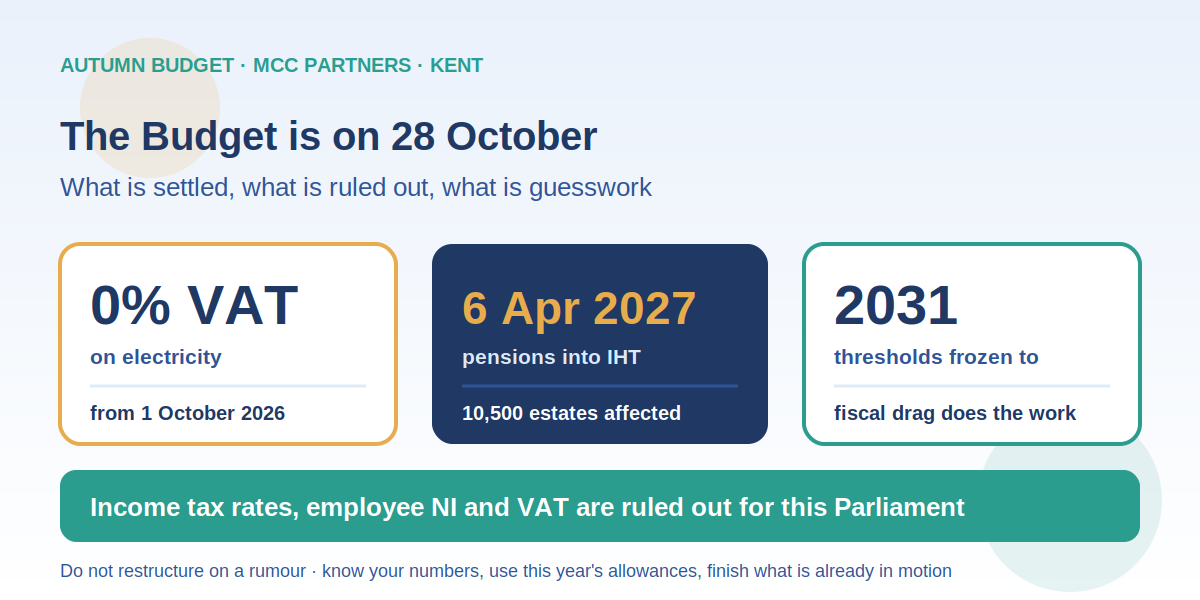
VAT on electricity goes to zero on 1 October
Domestic electricity moves to 0% VAT. Small businesses, charities and residential care homes that already qualify for the 5% reduced rate on their energy get it as well. It is worth around £45 a year to an average home and a good deal more if you run equipment all day.
This has already happened by the time you read this. Check your bill actually reflects it.
Business rates cut for pubs, clubs and live music venues
A 20% cut from April 2027, on top of the existing 15% relief. It covers roughly 32,000 businesses and the government reckons the typical pub saves about £1,100 in the first year. Good news if you are in that trade, and there are a few of you locally.
Unused pensions come into inheritance tax from 6 April 2027
This is the big one and it is the one people are least prepared for. From April 2027, unused pension funds fall into your estate for inheritance tax. Around 10,500 estates are expected to be caught that wouldn’t have been, and the average IHT bill on those estates is expected to rise by something like £34,000.
If your retirement plan involved leaving the pension untouched and passing it down, that plan changed. It is worth a proper conversation, and not in March 2027.
What is ruled out
The government has committed for the rest of this Parliament to no increases in income tax rates, employee National Insurance or VAT.
That matters more than it sounds, because it removes the three biggest levers. Whatever the Chancellor needs to raise has to come from somewhere else.
The obvious somewhere else is the one that is already running: frozen thresholds. The personal allowance and the rate bands are frozen to 2031. Nobody has to announce anything for that to raise money every single year, and it is why more of your staff creep into higher rate tax without anybody getting a pay rise worth having.
The other is enforcement. The stated plan is to raise an extra £10 billion a year by 2029/30 by closing the tax gap, which in practice means more HMRC compliance activity, more one-to-many letters, and more nudge campaigns. We are already seeing that in the post.
What is genuinely uncertain
Honestly? Capital gains tax, and the inheritance tax reliefs.
CGT sits at 24% on residential property gains for higher rate taxpayers. Further increases are speculated about every time a Budget comes round and so far have been guessed wrong more often than right. Corporation tax is widely expected to stay at 25%.
Business property relief and agricultural property relief were already reformed in 2024 and remain under scrutiny. A land value tax is being talked about and looks unlikely this time.
I have no inside knowledge on any of it and neither does anyone else quoting you a percentage in a newspaper.
What I’d actually do before 28 October
Here is my honest position, and it has not changed in years.
Do not restructure your business on a rumour. I have watched people sell a property, wind up a company or pull money out of a pension because of a Budget prediction that turned out to be wrong, and the tax it cost them to unwind was real when the change never came. The transaction has to make sense on its own terms first. If it only makes sense because of something that might be announced, it is not a plan, it is a bet.
What I would do is the boring list, because these are sensible whatever happens on the day.
1. Know your numbers now. If your year end has passed and the accounts aren’t done, you cannot react to anything, because you don’t know your own position. This is the single biggest thing.
2. If a transaction was already happening this year, get on with it. Not because of the Budget. Because deals that drift get taxed under whatever rules arrive, and certainty has a value of its own.
3. Use the allowances that exist today. ISA subscriptions, pension annual allowance, the dividend and CGT annual exemptions, capital allowances on equipment you were buying anyway. These are use-it-or-lose-it by tax year and they are not speculative.
4. Look at your pension plans in light of the April 2027 IHT change. That one is confirmed, it is coming, and it genuinely changes the order in which it makes sense to draw on different pots in retirement.
5. Check your profit extraction mix. Salary, dividend and pension contribution. Not because it is about to change, but because most owner-managed companies I look at have not revisited theirs since employer’s National Insurance went up, and the old split is often no longer the right one.
What happens after the 28th
We’ll put out a summary in the days following, written for owner-managed businesses and landlords rather than for tax specialists. Short, plain English, and only the bits that actually affect you. Most Budget coverage is written for people who already understand it, which rather defeats the point.
If something in it affects your business specifically, we will ring you. You should not have to work that out from a newspaper.
Accountancy, Tax, Law, and so much more Stay Informed!
Subscribe to our Newsletter


