


From Bookkeeper to Virtual FD: When Kent SMEs Outgrow Basic Compliance
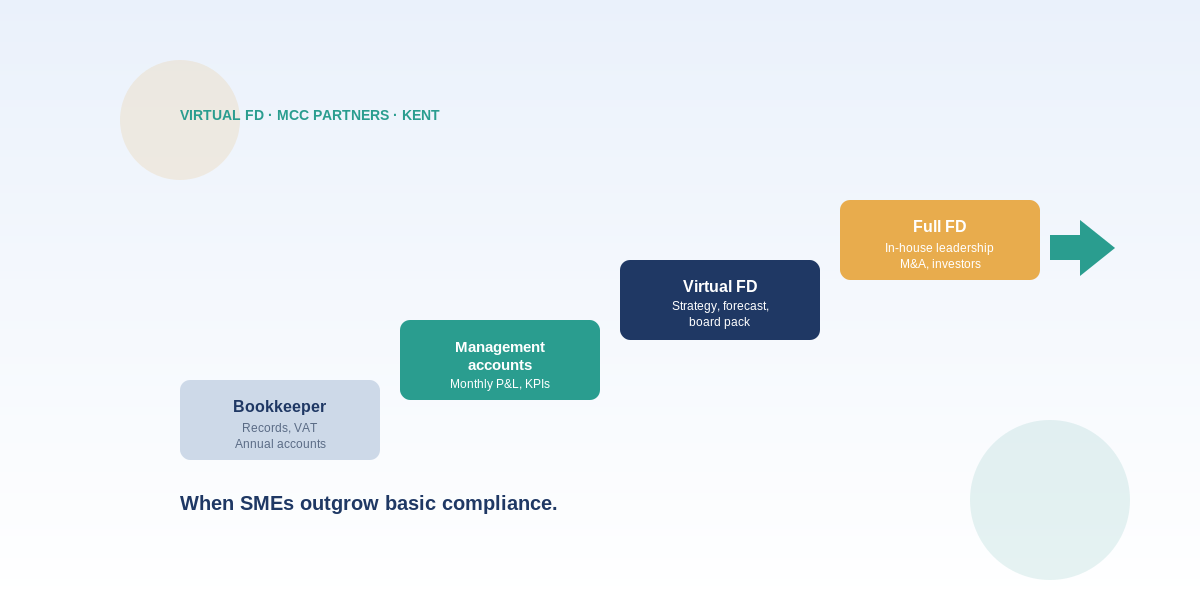
Most Kent SMEs start the same way. A bookkeeper enters transactions, an accountant files the year-end accounts, and the owner runs the business on instinct supported by a quick look at the bank balance. For a while, that combination works. Then, somewhere between £500,000 and £2 million of turnover, it stops being enough.
This post is about that transition. When have you outgrown basic compliance? What does the next level of finance support actually look like? And do you need a Virtual FD, or just better monthly information?
What basic compliance gives you
The standard small-business package is bookkeeping, payroll, VAT returns and statutory year-end accounts. Done well, it produces clean records, a tax return that does not surprise you, and management information that lags real life by 12 to 16 months.
That last point is the problem. By the time your statutory accounts arrive, the decisions they would have informed have already been made. For a stable lifestyle business, that latency is fine. For a growing SME making real choices about pricing, hiring, capital expenditure or borrowing, it is dangerous.
Five signs you have outgrown basic compliance
From our advisory work across Kent, the same patterns recur. If any three of these apply, you are probably already past the bookkeeper-only stage:
- You make decisions on the bank balance. Cash is real, but it is not the same as profitability. Decisions about pricing, hiring and investment based on cash alone produce predictable mistakes.
- You cannot answer the question “what was your gross margin last month?”. Or worse, you can answer it but the number you give is a guess.
- Your year-end accounts always contain at least one number that surprises you. A tax bill that came in higher than expected, a depreciation charge you did not see coming, a debtors balance you forgot about. Surprises mean the underlying numbers have been drifting unchecked.
- You have more than five employees or you carry stock. The complexity of payroll, holiday accruals, stock valuation and WIP makes monthly numbers worth far more than annual ones.
- You are thinking about borrowing, investing or selling. Banks, investors and buyers expect monthly management accounts and a forecast. The conversation you can have with a Virtual FD in the room is qualitatively different from the one you can have without.
The middle step: management accounts
Before the Virtual FD conversation, most growing SMEs benefit from a simple step: monthly management accounts. Done properly, these give you:
- A monthly profit and loss within 10 working days of month-end.
- A live balance sheet showing where the cash actually is.
- A rolling forecast for the next 12 months.
- Variance analysis against budget — not in the sense of a spreadsheet exercise, but a short narrative on what changed and why.
For a Kent SME turning over £500k to £1.5m, monthly management accounts typically cost £300 to £750 a month depending on transaction volume. The return on investment is almost always immediate: better pricing decisions, earlier cash interventions, fewer year-end surprises.
What a Virtual FD actually does
The Virtual FD — sometimes called a fractional FD or part-time FD — is a step beyond. They do not enter transactions or file VAT returns. They:
- Sit in the management team conversation, asking the questions a full-time FD would ask.
- Translate the management accounts into commercial insight: where margins are eroding, where customers are concentrating, where overhead is creeping.
- Build and stress-test the forecast.
- Lead the conversation with banks, investors and acquirers.
- Set up the financial control disciplines — budget cycles, board packs, KPIs — that a business outgrows the accountant’s back office for.
Typical pricing in Kent in 2026 is between £1,000 and £3,000 a month for half a day to two days of senior time. For a business doing £2m of turnover with thin margins, that investment usually pays for itself within a single quarter through better commercial decisions.
The four conversations Kent owners should expect with a Virtual FD
If you engage one, the early months should produce:
- A pricing review. Is your gross margin where it should be? What would a 3% price rise actually do to volumes? Is your discounting policy disciplined or accidental?
- A cash flow stress test. Can the business absorb a 20% drop in revenue for three months? What is the trigger point at which you would act?
- A customer concentration review. What percentage of revenue comes from your top three customers? What would losing one of them mean?
- A board pack. Even if it is just you reading it, a structured monthly pack changes how you think about the business. The discipline of producing it is half the value.
When you do not need a Virtual FD
Worth saying out loud: not every SME needs this level of support. A lifestyle business at £300k turnover, with stable customers and no growth ambition, is fine on solid compliance and an annual planning conversation. A business under £500k can usually get to the same outcome with management accounts and a quarterly check-in rather than a permanent Virtual FD relationship.
The Virtual FD investment makes most sense when growth, complexity or a transaction is on the horizon.
How MCC Partners can help
For our Kent clients, the move from compliance to advisory usually starts with monthly management accounts, then steps up to Virtual FD when complexity demands it. The team handling your numbers stays the same, but the conversation changes from “here is what happened” to “here is what we should do next”. That is the line that separates accountants who simply count things from accountants who help you build the business.
Accountancy, Tax, Law, and so much more Stay Informed!
Subscribe to our Newsletter
