


CIS in 2026: The Mistakes That Cost Kent Contractors Money
The Construction Industry Scheme has been part of the landscape for so long that many Kent contractors treat it as routine paperwork. The trouble is that the scheme has quietly tightened over the last few years, HMRC’s compliance attention has stepped up, and the cost of small mistakes has not stayed small.
Across our CIS client base in Gravesend and the surrounding area, we see the same handful of errors come up again and again. Most are completely avoidable. Here are the seven we trip up on most often, what they actually cost, and how to make sure your next CIS return is clean.
A quick CIS refresher
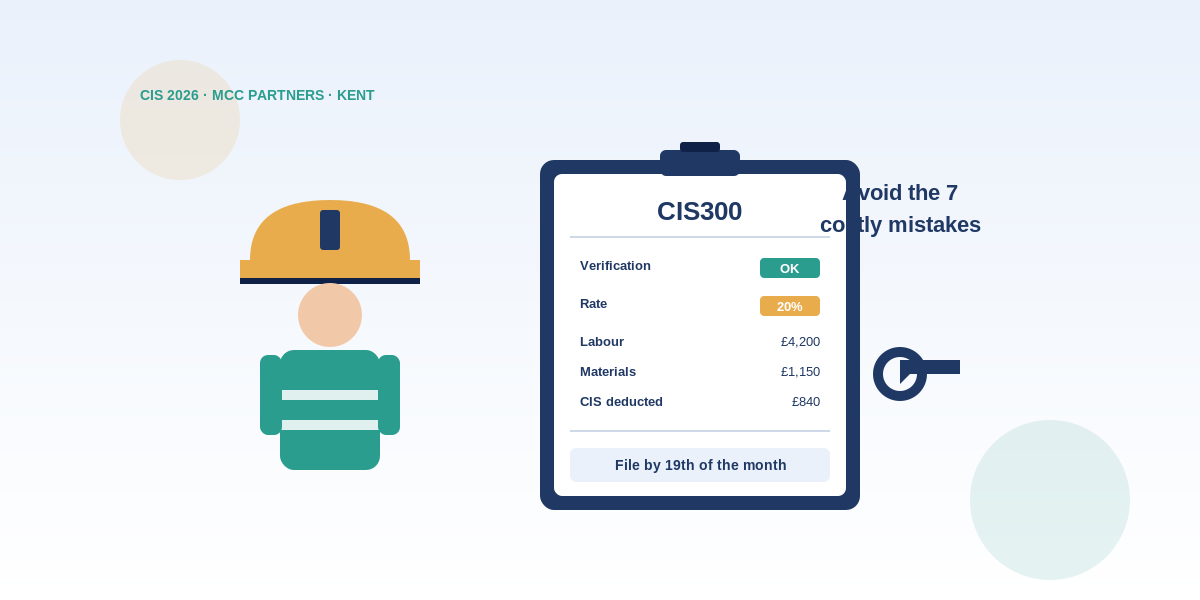
If you are a contractor in construction — or you are a business that spends more than £3 million a year on construction in a rolling 12-month window, even if construction is not your main trade — CIS applies. You verify your subcontractors with HMRC, deduct tax at 0%, 20% or 30% from their labour element, pay that deduction over to HMRC, and file a monthly CIS300 return.
Subcontractors then either reclaim the suffered CIS against their own tax bill (sole traders) or set it against their PAYE/CIS liabilities (companies). Sounds simple. The detail is where it bites.
Mistake 1: Skipping or sloppy verification
Every new subcontractor must be verified with HMRC before the first payment. Get a single digit wrong on a Unique Taxpayer Reference or a National Insurance number and the verification will fail, defaulting your deduction to 30% rather than 20%.
That single error is one of the most common causes of subcontractor complaints we see — and although the over-deducted tax is recoverable, the cash-flow damage to your trade subcontractors can sour relationships fast. Verify carefully, and keep the verification reference on file.
Mistake 2: Applying the wrong deduction rate
The three CIS rates are 0% (gross payment status), 20% (verified standard) and 30% (unverified or failed). The pattern of error we see most often is contractors continuing to pay a long-standing subcontractor at 20% when HMRC has actually moved them to 30%, or 30% when they have qualified for gross status.
HMRC reviews subcontractor status periodically. If your bookkeeping software is not pulling the latest status from HMRC every month, you are flying blind. Reverify any subcontractor you have not paid in the previous two tax years.
Mistake 3: Missing the 19th-of-the-month return
The CIS300 monthly return must be filed by the 19th of the month following the tax month it covers. A late or nil return triggers an automatic £100 penalty, rising quickly: another £200 at two months late, then 5% of the deductions (minimum £300) at six months, and again at twelve months. A single forgotten nil return can cost £1,000+ by the time HMRC catches up.
If you have no payments to subcontractors in a given month, file a nil return anyway. Then file a request to set inactive status if you genuinely do not expect to pay anyone for six months or more.
Mistake 4: Losing gross payment status without realising
Gross payment status is one of the most valuable CIS positions a subcontractor can hold — it means no deductions, immediate cash flow benefit and a meaningful competitive advantage when bidding for work. It is also one of the easiest things to lose without realising.
HMRC carries out an annual review against three tests: turnover (£30,000 net of VAT and materials per partner/director), compliance (clean PAYE, NIC, CT and VAT history) and business (genuinely in construction). A single late VAT return, missed PAYE payment or sloppy self-assessment can trigger removal. We have helped Kent contractors successfully appeal removal more than once, but the cleanest answer is to keep every other tax return spotless.
Mistake 5: Mishandling the materials versus labour split
CIS deductions apply to the labour element of an invoice only — not to genuine materials supplied by the subcontractor, nor to plant hire that is invoiced separately. Contractors who deduct CIS on the full invoice over-deduct, and subcontractors who do not split their invoices clearly invite the same outcome.
For Kent subcontractors invoicing main contractors, the fix is invoicing discipline: separate labour, materials and plant on every invoice, with VAT applied correctly to each line. For main contractors, train whoever processes the invoices to read each line, not just the total.
Mistake 6: Subcontractors not reclaiming CIS suffered
Limited company subcontractors should offset CIS suffered against their PAYE, NIC and CIS payable each month using the Employer Payment Summary (EPS). We routinely meet new subcontractor clients who have been paying their PAYE bill in full each month while sitting on five-figure unclaimed CIS balances at HMRC.
If the suffered total at year-end exceeds your liabilities, HMRC will refund the balance — but only once you ask. A monthly EPS habit prevents this entirely.
Mistake 7: VAT reverse charge confusion
The domestic reverse charge for construction services has been in place since March 2021, but five years in we still see it applied incorrectly. The basic rule: for most B2B construction services within CIS, the customer accounts for the VAT rather than the supplier charging it — unless the customer is an end user or intermediary supplier and has notified you in writing.
Two common slips: charging VAT when the reverse charge applies (leading to under-payment on your own VAT return), and failing to obtain end-user notifications in writing from the customer (leading to disputes during HMRC compliance visits). A simple end-user/intermediary letter template, signed by every customer once, removes most of the risk.
How MCC Partners handles CIS for Kent clients
For our CIS clients across Gravesend, Dartford and the surrounding area, we run a single monthly cycle that combines verification updates, deduction rate checks, CIS300 filing, EPS submission, reverse-charge invoice review and a brief end-of-month report. The work is fairly mechanical, but the discipline is everything. Done well, CIS becomes a non-event. Done badly, it is a slow drip of penalties, cash-flow surprises and HMRC letters.
Accountancy, Tax, Law, and so much more Stay Informed!
Subscribe to our Newsletter
