


Buying Commercial Property Through Your Limited Company in 2026
Growing Kent SMEs reach a moment when paying rent on a unit at the Imperial Business Estate, a workshop in Northfleet or an office in Gravesend stops feeling like a sensible operating cost and starts feeling like throwing money away. The temptation is to buy — and the next question is almost always “through the company, or personally?”.
The right answer is rarely obvious. This post walks through how we model the decision for our owner-managed clients in 2026, the four routes available, and the questions that drive a defensible recommendation.
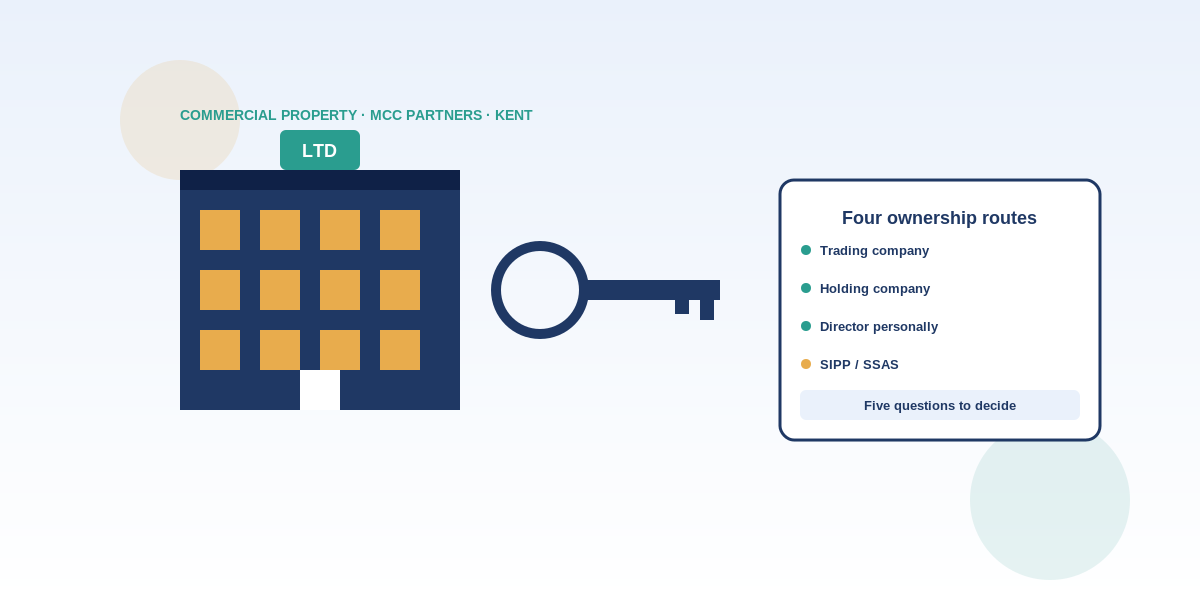
The four routes to owning your premises
For most Kent SMEs, the realistic options are:
- Trading company buys the property directly. Simplest legally, but ties the property to the trading risk of the business.
- Holding company structure. A parent company owns the property, the trading subsidiary rents it. Cleaner risk separation and useful at exit.
- Director buys personally and leases to the company. Common, flexible, but limits tax efficiency on the financing side.
- Self-Invested Personal Pension (SIPP) or SSAS buys the property. The pension scheme owns it and rents it to your company. Powerful for the right circumstances; tightly regulated.
What changes when the company buys
Three things make corporate ownership attractive:
- Interest on borrowings is deductible against corporation tax. A £500,000 commercial mortgage at 6.5% generates £32,500 of interest a year — saving up to £8,125 of corporation tax at the marginal rate.
- Capital allowances on integral features. Air conditioning, lighting, electrical systems and similar built into the building qualify for the AIA or the 50% first-year allowance for special-rate plant. On a typical £500,000 industrial unit, the embedded fixtures element is often £50,000–£100,000 of qualifying expenditure.
- No rent leakage out of the company. The cash that would have gone to a landlord stays inside the business.
Three things make it less attractive:
- Stamp Duty Land Tax (SDLT) is a real cost. Commercial SDLT in 2026 is 0% to £150,000, 2% to £250,000, then 5% above. A £500,000 unit attracts SDLT of around £14,500.
- Capital gains on a future sale go through the company. They are taxed at corporation tax rates and the proceeds need to be extracted to reach the director personally — potentially adding a layer of dividend tax.
- The property is exposed to trading creditors. If the trade fails, the property goes with it. This alone usually pushes us toward the holding company route or personal ownership for higher-risk trades.
The personal-ownership-with-lease route
Director buys the building, charges the company market rent. The rent reduces the company’s corporation tax bill but is taxed personally as property income (no NIC on rent, though). Mortgage interest is deductible against the rental income but only at basic rate — the restriction that has hit residential landlords also applies here for individuals.
The big advantage is risk separation and Business Asset Disposal Relief on future sale: a personally-owned commercial property used by your own trading company can qualify for BADR (14% in 2025/26, 18% from 6 April 2026) on the gain, which is far more attractive than corporate disposal.
The pension route (SIPP or SSAS)
A SIPP or SSAS buying your commercial premises has several appealing properties:
- The rent paid by the company is fully tax-deductible.
- The rent received by the pension scheme is tax-free.
- Any capital growth in the property is tax-free inside the scheme.
- The property sits outside your personal estate for IHT purposes.
The trade-off is complexity. Setting up an SSAS for an owner-managed company costs £3,000–£5,000 plus ongoing costs, requires pension trustees and FCA-authorised advice. It only works if you have meaningful pension assets — typically £200,000+ across the directors — and a building that fits within the scheme’s borrowing limit (50% of net assets).
When the conditions line up, the SSAS route is often the single most tax-efficient ownership structure available to a Kent SME owner. When they do not, it is overkill.
The questions that drive the decision
Five questions usually settle it within an hour of advice:
- How risky is the underlying trade? The higher the trading risk, the stronger the case for separating the property.
- What is your time horizon? Buying with intent to sell the trade within five years pushes you toward structures that preserve BADR.
- How much pension capital do you have? Above £200,000 of pension assets, the SSAS option is on the table.
- Are there other shareholders? Personal ownership of premises by one of several shareholders complicates everything.
- What does the financing look like? Lenders treat corporate, personal and SIPP/SSAS borrowing very differently; rates and LTVs vary.
A typical Kent SME path
For our clients buying their first premises, the most common recommendation in 2026 is: form a holding company, transfer the trade into a new subsidiary if not already structured that way, and have the holding company buy the property. The holding company charges rent to the trading subsidiary, both companies remain inside the small profits regime where possible, and the property is insulated from trade creditors.
For directors with substantial pension pots, the SSAS route is the next conversation. For higher-risk trades, personal ownership with a lease back remains the simplest answer.
Accountancy, Tax, Law, and so much more Stay Informed!
Subscribe to our Newsletter
