


HMRC Enquiries: What Triggers One and How to Handle It
Few things land on a Kent SME owner’s desk with the same chill as a brown envelope from HMRC announcing a compliance check. The reaction is almost always the same: a quick scan, a tight stomach, and a phone call to the accountant. The good news is that most enquiries are routine, manageable and end without anyone owing more tax. The bad news is that how you handle the first two weeks can decide whether the case stays routine or escalates.
This post explains what an HMRC enquiry actually is, what tends to trigger one in 2026, and the practical steps we take with our Kent clients when an enquiry letter arrives.
What an enquiry is — and is not
HMRC has the power to check almost any return. “Enquiry” is the formal term for a structured check into a self-assessment return, corporation tax return, VAT return or PAYE record. Most enquiries are either:
- Aspect enquiries — a question about a specific item on a return.
- Full enquiries — a wider review of the whole return and supporting records.
- Cross-tax enquiries — covering more than one tax at once, increasingly common since HMRC’s Connect data system started joining the dots.
An enquiry is not the same as a criminal investigation. HMRC’s Code of Practice 9 (suspected fraud) and Code of Practice 8 (high-value tax planning) are separate, far more serious processes. The overwhelming majority of letters our Kent clients receive are routine compliance checks under Schedule 36 of the Finance Act 2008.
The triggers we see most often
HMRC does not publish its triggers, but the patterns across our enquiry casework in 2025 and 2026 are consistent:
- R&D tax credit claims. Enquiry rates remain elevated since the 2022 crackdown. A poorly documented claim, even a valid one, is highly likely to be reviewed.
- Big year-on-year changes. A sudden swing in turnover, gross margin or expense ratios attracts attention. So does a long-loss-making business that suddenly turns profitable, or vice versa.
- Mismatches between returns. Connect cross-references your CT600 to VAT returns, PAYE submissions, Companies House filings, bank account data and even Land Registry. Inconsistencies generate review flags.
- Third-party data. Sale of a buy-to-let, an investment account, an overseas income source. Banks and platforms file data automatically; HMRC matches it to your return.
- Sector-based campaigns. HMRC runs targeted campaigns — in recent years on cash businesses, online sellers, landlords and the construction sector.
- Cash businesses with low margins. Restaurants, taxis, salons, small construction firms remain perennial targets where margins look thin relative to industry norms.
- Random selection. A small percentage of enquiries are genuinely random. You can do everything right and still be picked.
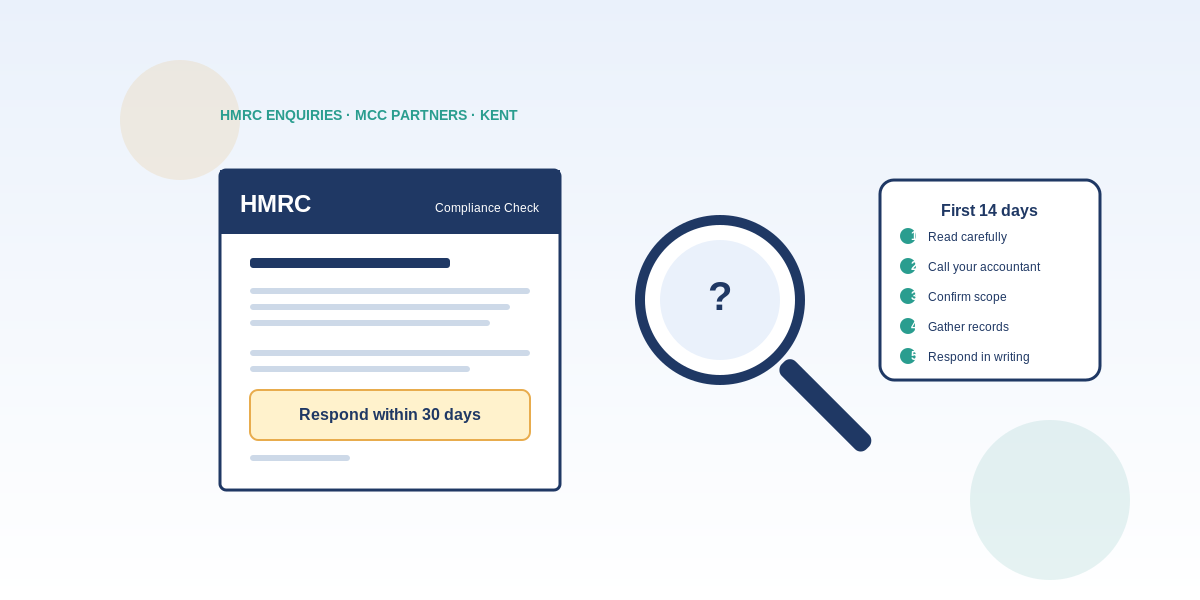
What to do in the first 14 days
When an enquiry letter arrives, the first two weeks matter more than the next six months. Our standard checklist:
- Do not respond immediately. Read the letter carefully, note the deadline (usually 30 days), and call your accountant the same day.
- Confirm the scope. Aspect or full enquiry? Which return? Which tax? Which specific items? HMRC’s opening letter usually flags this, but the wording can be ambiguous.
- Check the time limits. Enquiries into a self-assessment must usually be opened within 12 months of the filing date. If HMRC is outside that window, they need “discovery” grounds, which they must establish.
- Authorise your accountant to act. Submit a 64-8 (agent authorisation) so HMRC corresponds with us directly. This filters the tone, controls the pace and prevents off-the-cuff answers.
- Gather supporting records. The records HMRC can request are wide but not infinite. Provide what is asked for, in a structured way, with an indexed schedule. Do not volunteer additional records.
- Document everything. Every call, every meeting, every commitment. Notes become evidence.
- Resist requests for a face-to-face meeting at first. Initial information requests should be handled in writing. Meetings can come later if needed, with your accountant present.
The mistakes that escalate a routine check
Four patterns we see turning small enquiries into bigger problems:
- Volunteering more than asked. “Just to be helpful” answers open new lines of enquiry. Stay on the question.
- Inconsistent answers. If you cannot remember, say so. Making something up that contradicts the records is worse than a gap.
- Missing deadlines. HMRC penalties for failure to respond compound quickly. If you need more time, ask in writing before the deadline.
- Ignoring it. Enquiries do not go away. The earliest you engage, the better the eventual outcome.
Fee Protection Insurance is worth considering
HMRC investigations can run for many months and rack up significant accountancy fees defending them — even when no additional tax is found. Most accountants in Kent, including MCC Partners, offer fee protection schemes (typically £100–£300 a year for an SME) that cover the professional cost of representing you through an enquiry.
For the cost of a tank of fuel a year, it removes the financial calculus from how you respond. We strongly recommend it for any client trading meaningful turnover, claiming R&D, owning multiple properties or running a cash-heavy business.
How MCC Partners handles enquiries
For our clients across Gravesend and Kent, an HMRC enquiry is something we manage from the first letter to the closing notice. We control correspondence, prepare information packs to a consistent standard, and frame each response to minimise scope creep. The aim is to close the enquiry cleanly, in months not years, with no surprises.
Accountancy, Tax, Law, and so much more Stay Informed!
Subscribe to our Newsletter
