MTD Quarterly Updates Explained: A Step-by-Step Guide for Sole Traders in Kent
One of the biggest changes under Making Tax Digital for Income Tax is the shift from a single annual tax return to four quarterly updates submitted throughout the year. For many self-employed business owners in Kent, this is the part of MTD that raises the most questions. What exactly do you need to report? When are the deadlines? And how much extra work is actually involved?
At MCC Partners in Gravesend, we believe that once you understand the process, quarterly updates are far less daunting than they first appear. Here is our step-by-step breakdown of everything you need to know.
What Are MTD Quarterly Updates?
Quarterly updates are digital summaries of your business income and expenses that you submit to HMRC through MTD-compatible software. They cover three-month periods throughout the tax year and give HMRC a running picture of your financial position.
Crucially, these are not mini tax returns. You do not need to calculate your tax liability at each quarter, nor do you need to make complex accounting adjustments. You are simply providing a summary of what you have earned and what you have spent in each quarter.
The Key Deadlines You Need to Know
The tax year runs from 6 April to 5 April, and your quarterly update deadlines follow a fixed schedule. You have approximately one month after each quarter ends to submit your update:
Quarter 1 covers 6 April to 5 July, with a submission deadline of 7 August.
Quarter 2 covers 6 July to 5 October, with a submission deadline of 7 November.
Quarter 3 covers 6 October to 5 January, with a submission deadline of 7 February.
Quarter 4 covers 6 January to 5 April, with a submission deadline of 7 May.
There is also the option to elect for calendar quarter reporting, which aligns your quarters to the end of each calendar month instead. Your accountant can advise whether this suits your business better.
What Information Do You Need to Report?
Each quarterly update requires a summary of your income and expenses for that period, broken down by category. This includes the total amounts received and the total amounts spent across standard expense categories such as cost of goods, travel, office costs, and so on.
If you have more than one business, say a trade and a rental property, you will need to submit separate quarterly updates for each source of income. A sole trader who also lets a property would therefore make eight quarterly submissions in a year.
What Happens If You Make a Mistake?
One reassuring aspect of the quarterly update system is that updates are cumulative. This means that if you make an error in one quarter, you can correct it in the following quarter without needing to submit a formal amendment. HMRC has designed the system to allow for corrections as part of the normal quarterly cycle.
The Final Declaration
After your fourth quarterly update, you will need to complete a final declaration by 31 January following the end of the tax year. This is where you bring together all your business income, declare any other taxable income such as employment earnings, savings interest, or dividends, and claim any reliefs or allowances. It effectively replaces the traditional Self Assessment tax return.
Penalty Easement for the First Year
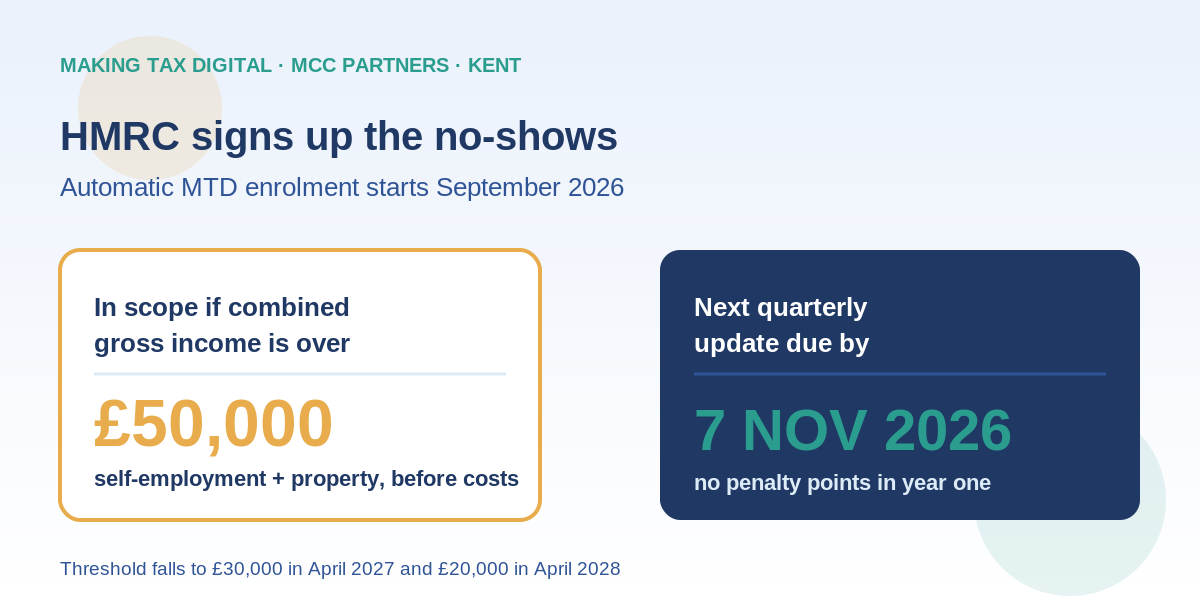
HMRC has acknowledged that the transition will take some getting used to. For those joining MTD for ITSA in April 2026, there will be no penalty points issued for late submission of your first four quarterly updates. However, this easement does not apply to your final declaration or to late payment of any tax owed, so it is still important to aim for timely submissions from the outset.
How MCC Partners Can Make This Simple
For sole traders across Gravesend and Kent, the shift to quarterly reporting might feel like a big change, but with the right support it can actually make your financial management easier. Regular updates mean fewer surprises at year end and a clearer picture of your tax position throughout the year.
At MCC Partners on Saddington Street in Gravesend, we can help you set up the right software, establish a quarterly routine, and handle the submissions on your behalf. Whether you want us to manage the entire process or simply guide you through the first few quarters, we are here to help. Get in touch today to start preparing for your first MTD quarterly update.

Accountancy, Tax, Law, and so much more Stay Informed!
Subscribe to our Newsletter