


Pricing Your Services as a Kent SME: A Finance Lens
Ask ten Kent SME owners how they set their prices and you will get ten answers, most of them variations on “we worked out what we needed to charge to cover our costs and added a bit”. It is the single most common pricing approach we see in our advisory work, and it is also the one that quietly leaves the most money on the table.
This post is not a marketing piece. It is a finance lens on how pricing actually affects profit, why most SMEs underprice, and the four pricing models worth knowing in 2026.
The 3% price rise that transforms everything
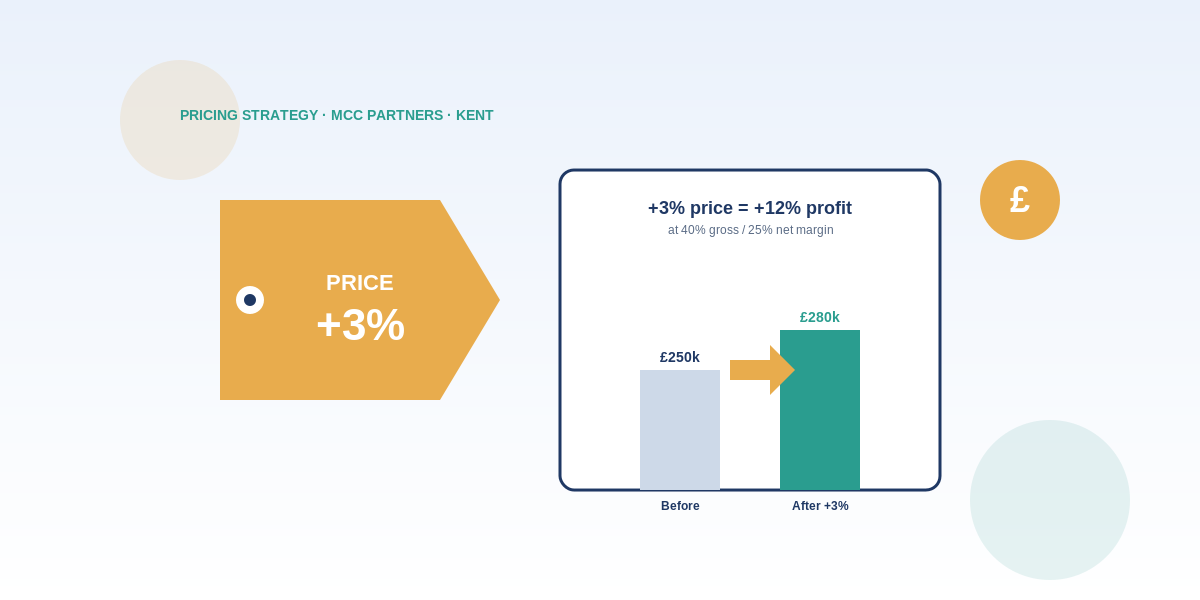
Take a Kent service business turning over £1 million, with a 40% gross margin and 25% net margin. Net profit: £250,000.
Hold volume steady and add 3% to prices. Turnover rises to £1.03 million. Gross profit rises by £30,000 (price rises flow almost entirely to gross profit if costs do not move). Net profit rises to £280,000. A 12% jump in profitability from a price change most customers would not consciously notice.
The same 3% as a cost cut would require finding £30,000 of efficiencies somewhere in the business — far harder. Yet most SME owners we work with spend ten times more energy on cost management than on pricing.
The four pricing models
Worth knowing the canonical four so you can place where you are now and where you could be:
1. Cost-plus pricing
Calculate your costs, add a margin, charge that. Simple, fair, defensible — and almost always leaves money on the table because it ignores what the customer actually values. Most start-ups begin here. Most mature businesses should have moved on.
2. Competitor-based pricing
Look at what others charge and price close to them. Useful as a sanity check, dangerous as a strategy. You end up reacting to your competitor’s mistakes, and racing toward the bottom in markets where your service is not actually comparable.
3. Value-based pricing
Price based on the value delivered to the customer, not the cost of producing it. The classic example: an accountant who saves a client £20,000 in tax can charge £3,000 for the advice, regardless of how many hours it took. Hard to land, easy to expand once you do.
4. Tiered pricing
Three or four packages at different price points. Done well, tiered pricing anchors the customer’s perception of value, captures customers who would otherwise walk away, and pushes others to the higher tier because the upgrade looks cheap relative to the next one down. Used widely in software; underused in professional services.
Five maths errors that erode SME margins
From our advisory casework, the five most common pricing mistakes:
- Confusing markup with margin. A 50% markup is a 33% margin. A 100% markup is a 50% margin. Pricing software prompts you to enter one or the other and SMEs routinely get the wrong number.
- Pricing on labour hours but quoting fixed fees. The hours overrun, the fee does not, and profitability evaporates. Either price on time or price on outcome — do not mix the two.
- Forgetting overhead recovery. Direct cost is rarely the whole picture. Rent, utilities, software, owner time, the cost of carrying debtors — all of these need to be allocated, not ignored.
- Discounting in fixed amounts. A £200 discount off a £1,000 invoice is a 20% revenue reduction and, depending on margin, a 40–60% profit reduction. Discount lightly, and only with intent.
- Holding prices steady for years. Inflation, employer NIC, energy and software costs are all rising. Holding prices flat is a real-terms price cut, every year.
The two questions to ask before raising prices
Most SME owners over-estimate the customer pushback they will get from a price rise. Two questions usually clarify it:
- When did you last raise prices, and how many customers did you lose? Often the answer is “two years ago and none”. That tells you the elasticity is lower than you fear.
- What is your churn rate today? If customers stick around year on year, they are buying something they value. Value-based customers absorb small price rises easily. Price-sensitive customers leave anyway for reasons unrelated to the rise.
A 3–5% annual price rise, communicated calmly and on a predictable cycle, is something almost every Kent SME we work with can absorb without churn.
How to think about pricing in 2026 specifically
The cost base has moved meaningfully over the last 18 months. Employer NIC at 15%, frozen thresholds dragging income tax up, energy still well above 2019 levels, software subscriptions continuing to climb. A business holding its prices since 2024 has effectively given itself a 4–6% pay cut.
The clients who are thriving in 2026 are the ones who have built an annual price review into their calendar — usually in October, in time for any change to take effect in January — and treat it as a routine commercial decision, not a difficult conversation.
How MCC Partners helps
For our advisory clients across Kent, an annual pricing review is one of the standing items in the autumn conversation. We look at margin trends, customer concentration, discounting discipline and the gap between the cost of delivery and what the market would pay. The recommendations are usually small — a 4% rise here, a tier adjustment there — but the cumulative effect on profitability is rarely small.
Accountancy, Tax, Law, and so much more Stay Informed!
Subscribe to our Newsletter
