


Start Early: Your Summer Year-End Tax Planning Checklist for SMEs
The first conversation about tax-year-end planning is almost always too late. By February, most of the options that could have meaningfully changed an SME’s tax position are off the table. Pensions take weeks to set up. Capital expenditure decisions need procurement lead times. Reorganisations need professional advice and signed paperwork.
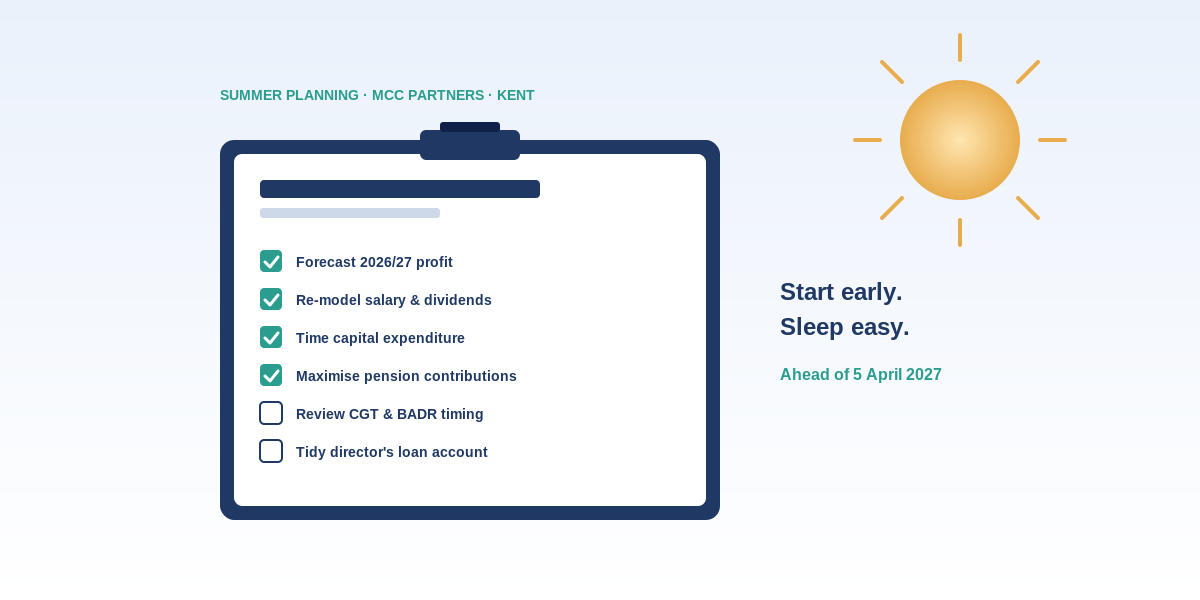
That is why we run our SME planning conversations with Gravesend and Kent business owners in July and August. Trading is steadier, clients have time to think, and there are still nine months until 5 April 2027 to put decisions into effect. This is the 12-point checklist we work through with clients each summer.
1. Forecast your 2026/27 numbers
Start with a credible forecast of trading profit, dividends and personal income for the full tax year. Without a forecast, every other item on this list is guesswork. A simple model showing profit by month, dividends planned, and other income is enough — the precision matters less than the discipline.
2. Re-model salary and dividend levels
The combination of employer NIC at 15%, a static £500 dividend allowance and frozen personal thresholds means the optimum salary-dividend mix is rarely what it was two years ago. Re-run the calculation each summer. For most director-shareholders we are recommending a salary at the secondary NIC threshold, then dividends sized to the company’s ability to pay.
3. Check the corporation tax marginal band
If your forecast profits sit between £50,000 and £250,000, you are inside the 26.5% effective marginal rate. Three levers reduce the impact:
- Employer pension contributions.
- Bringing forward qualifying capital expenditure to claim full expensing.
- Reviewing associated companies, which can divide the £50,000 and £250,000 thresholds.
4. Use the Annual Investment Allowance and full expensing
The £1 million AIA remains permanent. Full expensing on new and unused qualifying plant and machinery is also still available to companies. If you have capital expenditure planned for the next twelve months, the question is rarely “should we spend the money?” but “when does it most help?”. Timing purchases before year-end can bring forward significant relief.
5. Maximise pension contributions, especially employer ones
For owner-managed companies, employer pension contributions are still one of the most tax-efficient ways to extract value:
- Corporation tax relief on the contribution.
- No income tax or National Insurance.
- The annual allowance is £60,000 per person, and unused allowance from the previous three tax years can be carried forward.
If you have not used your full allowance over the last few years, summer is the right time to take advice and arrange the contribution well before March panic-mode.
6. Use ISA and pension allowances personally
The personal allowances are “use it or lose it”. The ISA allowance is £20,000 per adult, the Junior ISA allowance is £9,000 per child, and the pension annual allowance is £60,000 (with possible tapering and carry-forward). Setting up monthly contributions in August beats lump-sum-ing them on 4 April.
7. Review capital gains tax exposure
The annual exempt amount for individuals is £3,000. Higher capital gains tax rates of 18% and 24% are now in full effect on non-residential disposals. Business Asset Disposal Relief rises from 14% to 18% from 6 April 2026, and if you are planning a disposal in the next two or three years, the timing question is bigger than the calculation.
For investment portfolios held in your personal name, summer is the right window to consider:
- Bed-and-ISA to crystallise gains within the allowance.
- Bed-and-spouse to share allowances between partners.
- Any planned property or share disposals over the next twelve months.
8. Tidy up loans, directors’ current accounts and dividends
Overdrawn directors’ loan accounts are still one of the most common compliance issues we see at year end. Section 455 tax kicks in at 33.75% on balances not repaid within nine months and one day after year end. Spotting this in July, with eight months still to run, is straightforward. Spotting it in March can be expensive.
9. R&D claims: pre-notify if you might claim
If there is even a chance you have qualifying R&D activity in the year, register your pre-notification with HMRC now. The deadline is six months after the period end. Missing it invalidates the claim regardless of the underlying work.
10. EMI and share schemes for key staff
If you are growing and want to retain key people, Enterprise Management Incentive (EMI) options are still one of the most generous staff incentive regimes anywhere. Putting a scheme in place takes around six to eight weeks, including HMRC valuation, so summer is the right time to start if you want options granted before year end.
11. Review your accountant’s house view on inheritance tax and exit planning
Inheritance tax planning is no longer a topic for the very wealthy. The frozen nil-rate band and the residence nil-rate band mean more SME owners are exposed than ever. Business Property Relief still applies in most owner-managed companies but is subject to active policy review. Exit planning — whether to a third party, an EOT, or family — usually has a three-to-five-year horizon. Either is a conversation to start in summer, not the week before the accountant calls.
12. Book the planning meeting before October
This is the most important item on the list. Calendar a structured tax-planning meeting with your accountant for September or October. Forty-five minutes, with the forecast and last year’s tax computation in front of you, will identify the two or three actions worth taking. The remaining months give you the time to execute them properly.
The MCC Partners view
SMEs that plan early do not pay significantly less tax because they are clever. They pay less because they have the time to make sensible decisions. Pensions are funded over months, not days. Capital expenditure is timed to commercial sense, not tax panic. Reorganisations are paperwork in October, not crisis management in March.
The single highest-return hour you will spend on your business this summer is sitting down with these twelve items and a credible forecast. Even if you only act on three of them, you will reach 5 April 2027 with a materially better position than the SME owner who starts thinking about tax in February.
Accountancy, Tax, Law, and so much more Stay Informed!
Subscribe to our Newsletter
