Gross or Net? The Richard Branson Fishing Story Explains It Better Than I Can
I’m going to tell you a story about Richard Branson, and then I’m going to tell you why I think about it most weeks.
Branson was in his fifties. He was in a board meeting, being taken through the numbers for a business he had built himself, and he could not tell whether what he was hearing was good news or bad news. He is dyslexic, and gross and net had simply never landed for him.
Afterwards one of his directors took him aside. He took a sheet of paper, coloured it blue for the sea, and drew a fishing net in it with some fish caught inside. The fish in the net, he said, are your net profit. The rest of the ocean is your gross turnover.
Branson got it instantly. And his reaction, which is the part I love, was roughly: I realised I was poorer than I thought. I always thought it was the other way round.
Why I keep coming back to it
Two reasons.
The first is that a man who had built one of the best known companies in Britain got to his fifties without being clear on it, and nobody had found a way to explain it to him. That is not a failure on his part. That is a failure on the part of every person who ever presented him a set of accounts.
The second is that he had it backwards in the direction that flatters you. He thought the bigger number was his. Almost everybody does. I have sat opposite business owners who genuinely believed a £400,000 turnover meant they were doing well, and who went quiet when we got to the bottom of the page.
So no, you are not being slow if this trips you up. You are in good company.
The simple version
Gross is before things are taken off. Net is after.
That is it. The whole thing. Everything else is just a question of what “things” means in that particular sentence, and that is where it gets slippery, because the answer changes depending on what you are looking at.
Gross and net profit
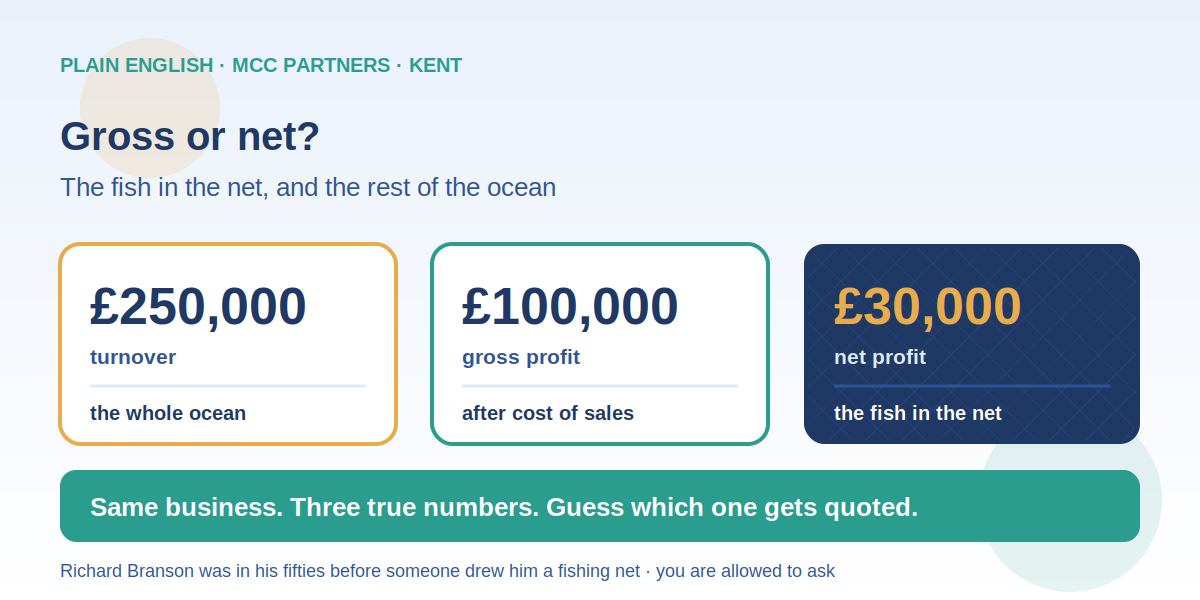
Take a business turning over £250,000 a year.
Cost of sales, being the materials and the direct labour that went into the work, comes to £150,000. That leaves gross profit of £100,000, or a 40% gross margin.
Then the overheads. Rent, insurance, the van, the accountant, the phone, the software, your own salary. Say £70,000. That leaves net profit of £30,000.
Three numbers, all true, all describing the same business: £250,000, £100,000 and £30,000. When someone at a networking event tells you what their business does, you have no idea which one they are quoting. Usually it is the first.
And the £30,000 still isn’t yours. Corporation tax at the 19% small profits rate takes £5,700 of it, leaving £24,300 before you take a penny out.
The useful one is the gross margin, by the way. If your gross margin is falling, you have a pricing or a buying problem, and no amount of cutting the phone bill will fix it. I’d rather talk to a client about their gross margin than almost any other number.
Gross and net pay
This is the one your staff care about, and the one that causes the most awkward conversations.
A £35,000 salary is a gross figure. The personal allowance covers the first £12,570, so £22,430 is taxed at 20%, which is £4,486. National Insurance at 8% on the same slice is about £1,794.
Take those off and the employee sees roughly £28,720 a year, or about £2,393 a month, before any pension or student loan.
Meanwhile the cost to you as the employer is higher than £35,000, once employer’s National Insurance and the pension contribution go on top. So the same job is one number to the person doing it, a bigger number on the contract, and a bigger number again in your accounts. If you have ever had someone ask why their payslip doesn’t match what you offered them, this is why, and it is worth explaining properly at the offer stage rather than on payday.
Gross and net in CIS
If you are in construction, you meet this one every month.
A registered subcontractor invoices £1,000 of labour. The contractor deducts 20% and pays over £800. That £200 goes to HMRC as an advance payment towards the subcontractor’s tax and National Insurance. It is not a fee and it is not lost, but it is gone from this month’s cash flow.
Unregistered, the deduction is 30%. With gross payment status, it is 0% and the subcontractor is paid the full amount and settles up with HMRC later.
Which is why gross payment status is worth applying for if you qualify. On £200,000 of labour a year, it is the difference between £40,000 sitting with HMRC through the year and £40,000 sitting in your account. Same tax at the end. Very different twelve months.
One thing worth saying plainly: materials are excluded from the CIS deduction. If your invoices don’t split labour and materials clearly, the deduction gets taken on the lot, and I see that cost subcontractors real money every year.
Gross and net rent
Landlords, this is where the confusion gets expensive.
A property let at £1,250 a month brings in £15,000 of gross rent a year. Take off the agent’s fees, the insurance, the repairs, the gas safety certificate and the service charge, and you might be at £11,000.
Then the mortgage interest, which is where people go wrong, because since Section 24 finished bedding in, mortgage interest on a personally held residential property is not an expense you deduct. It is a 20% tax credit applied after your tax is worked out. So your taxable profit is higher than the money you actually have, and higher rate taxpayers feel that hard.
I have written separately about what landlords can and cannot claim and about Section 24 specifically, and if you hold property personally they are worth ten minutes of your time.
And one more, because it is about to matter
Making Tax Digital for Income Tax uses qualifying income to decide whether you are in it, and qualifying income is gross. Turnover from self-employment and property combined, before a single expense comes off.
So a landlord with £55,000 of rent coming in and £15,000 of costs has £40,000 of profit and is still inside MTD, because the test looks at the £55,000. I have had this conversation more than once this year, and it always starts with somebody who was sure they were under the threshold.
What I actually want you to take from this
Not the definitions. You can look those up.
What I want is for you to feel completely fine asking. If Richard Branson needed a picture of a fish drawn for him at a board meeting, you are allowed to stop me mid-sentence and say “hang on, which one is that?”
The version of this job I don’t want to do is the one where a client nods along in a meeting, says thank you, and drives home with no clearer idea of how their business is doing than when they arrived. That happens a lot in this profession and it is our fault, not the client’s.
So ask. Every time. I would far rather draw you a fishing net.
Accountancy, Tax, Law, and so much more Stay Informed!
Subscribe to our Newsletter