Missed Your First MTD Quarterly Update? You Have Until 7 November
Making Tax Digital for Income Tax went live on 6 April this year, and the first quarterly update was due on 7 August.
A lot of people missed it. Around 864,000 sole traders and landlords came into the regime this April and I would be amazed if anything close to all of them filed on time. If you are one of the ones who didn’t, this post is for you, and the headline is better than you are probably expecting.
The good news first
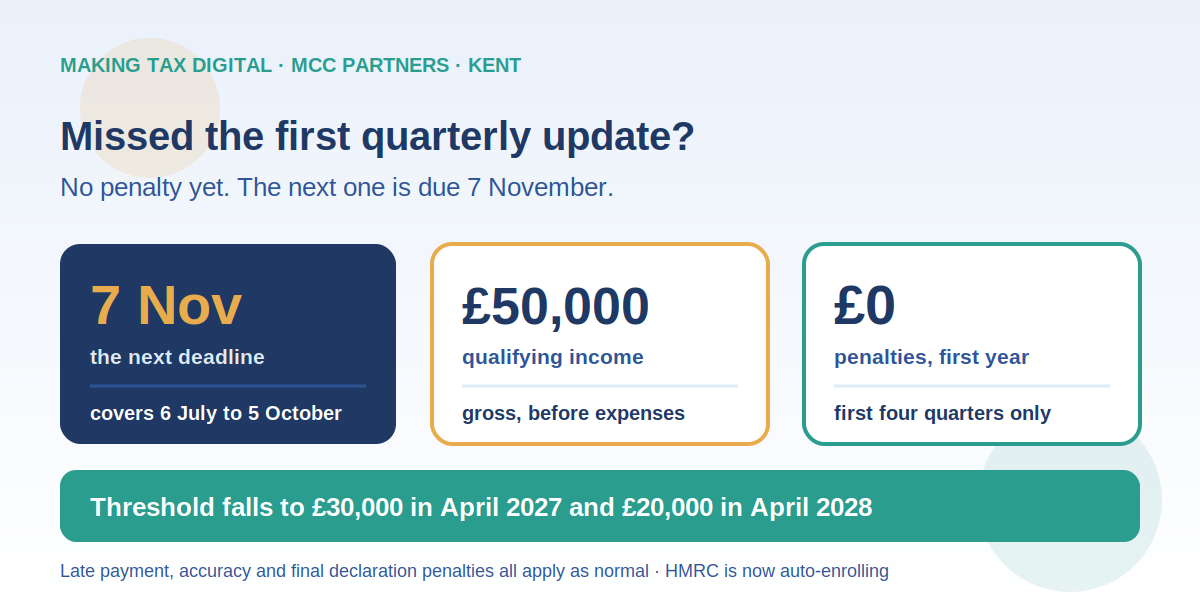
HMRC is running a soft landing for the first year. There are no late submission penalty points for the first four quarterly updates.
So if you missed 7 August, you have not been fined and you are not going to be for that one. Take the weight off.
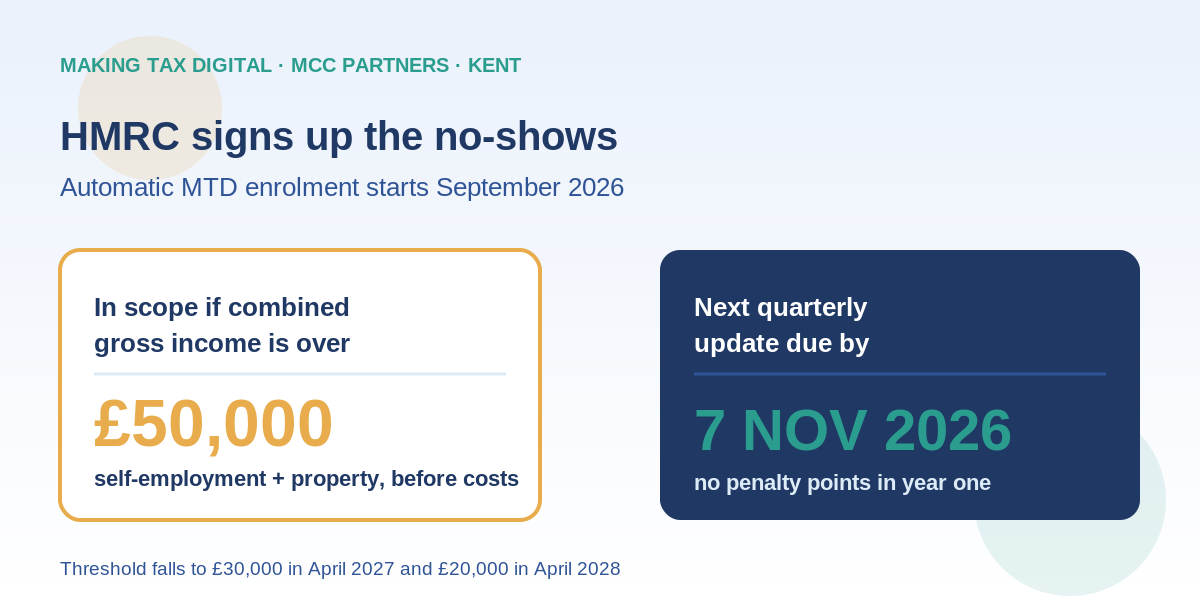
The next deadline is 7 November 2026, covering 6 July to 5 October. Then 7 February 2027, then 7 May 2027. Your final declaration for 2026/27, which is the one that replaces the old self assessment return, is due by 31 January 2028.
The bit the soft landing does not cover
This is where I want to be careful, because “no penalties in year one” has been repeated so often that people have heard it as “nothing matters in year one”. It doesn’t mean that.
The waiver is for late quarterly updates only. It does not cover:
- Late payment of tax. Those penalties and the interest apply exactly as normal.
- The final declaration. Miss that and you are penalised in the usual way.
- Accuracy. Penalties for careless or deliberate errors were never suspended.
And from the fifth quarterly update onwards, which is 7 August 2027, the points system starts for real. One point per late update, and once you hit four points you get a £200 penalty. Four points is one year of quarterly updates. You can accumulate a full set of points without ever being more than a few days late.
HMRC has started signing people up itself
Worth knowing. From September, HMRC began automatically enrolling people who should be in MTD and haven’t signed up.
So the strategy of waiting to see whether it applies to you has an expiry date, and it has passed. If you are in scope, you are going to be in the regime whether you volunteer or not. Better to arrive on your own terms with software you have chosen.
Am I even in it? The bit that catches people out
You are in MTD for Income Tax from April 2026 if your qualifying income was over £50,000 in the 2024/25 tax year.
Qualifying income is gross. Turnover from self-employment and property, added together, before a single expense comes off.
I cannot stress this enough because it is the single most common mistake I have seen this year. A landlord with £55,000 of rent and £18,000 of costs has £37,000 of profit and is still inside MTD, because the test looks at the £55,000. Same for a sole trader with £60,000 of sales and £25,000 of materials.
It is also the combined figure. £30,000 of self-employment and £25,000 of rental income is £55,000 of qualifying income, even though neither on its own would have got you there.
If you have been reassuring yourself that you are under the threshold, go and check the gross figures on your 2024/25 return before you rely on it. I wrote a whole post on the difference between gross and net recently, and this is precisely why it matters.
And it is coming down
The threshold drops twice more.
- April 2027: £30,000, based on your 2025/26 return
- April 2028: £20,000, based on your 2026/27 return
At £20,000 gross, a single buy-to-let at £1,700 a month is in. If you have one property and have assumed this is a big-business problem, it reaches you in April 2028, and the figures it is judged on are the ones you are recording right now.
What to do this week
Four things.
1. Get the August quarter submitted
Even though it is late and even though there is no penalty. Leaving it open makes the November filing harder and muddles your records. Get it in.
2. Check you are actually signed up and authorised
Being in scope and being registered are two different things, and your accountant needs a specific MTD authorisation which is not the same as the agent authorisation they already hold for self assessment. It is a common gap. Ask the question.
3. Sort the bookkeeping, not just the software
This is the real change and nobody enjoys hearing it. Quarterly filing means quarterly bookkeeping. The shoebox in January does not work any more, because there are now four deadlines a year instead of one.
The clients finding MTD painless are the ones whose records were already being kept monthly. The ones finding it hard are the ones doing a year’s bookkeeping four times a year instead of once. If that is you, changing the habit is worth more than changing the software.
4. Diarise 7 November
And 7 February, and 7 May. Put them in now while you are thinking about it.
My honest view on all this
MTD has been announced, delayed, rescoped and delayed again for the best part of a decade, and I understand completely why people stopped believing it would happen. That is a perfectly reasonable conclusion to have drawn from the evidence.
But it is here now. The software is fine, the quarterly updates themselves are genuinely quick once the bookkeeping is current, and the first year is the cheap one to get wrong. Next year is not.
If you have been putting it off, this autumn is the moment to sort it, while a mistake still costs you nothing.
Accountancy, Tax, Law, and so much more Stay Informed!
Subscribe to our Newsletter